Here are some key points to consider:
- Cracked and worn concrete in Sydney schools is not just an eyesore, but a safety hazard, and resurfacing is the quickest and most cost-effective solution.
- Concrete resurfacing involves bonding a new layer directly onto the existing concrete, eliminating the need for expensive and disruptive full demolition and replacement.
- Schools, retirement villages, and council pathways can all benefit from resurfacing, especially when slip resistance and durability are essential.
- Choosing the right finish is important — spray-on coatings, stencilled patterns, and epoxy systems each have different uses in high-traffic public areas.
- Choosing the wrong contractor can end up costing more in the long run — we cover what to ask before signing anything later in this article.
Many of Sydney’s schools and public spaces are quietly dealing with a concrete crisis — and too often, facility managers don’t take action until after someone has been injured.
Wizcrete is a top concrete resurfacing company in Sydney. They specialize in restoring worn out surfaces in schools, retirement homes, and public spaces managed by the council. They offer an affordable alternative to ripping everything out and starting from scratch.
Public Spaces in Sydney Face a Concrete Problem That Needs a Solution
Take a stroll through any school in Sydney that was built before the year 2000 and you’ll notice something: concrete playgrounds marked by surface cracks, sports courts with faded line markings, and pathways that have risen and settled unevenly over the years. It’s not just an eyesore — it’s a liability. Cracked surfaces snag shoe soles, create tripping hazards for running children, and deteriorate further each time Sydney experiences a rainy season.
Concrete doesn’t fail, it just gets old. And in busy places, it gets old faster than you’d think. Schools, old folks’ homes, council footpaths – they all have one thing in common: non-stop foot traffic and hardly any time for repairs. That’s why, all over Greater Sydney, facility managers are choo
sing resurfacing instead of replacement.
Understanding Concrete Resurfacing
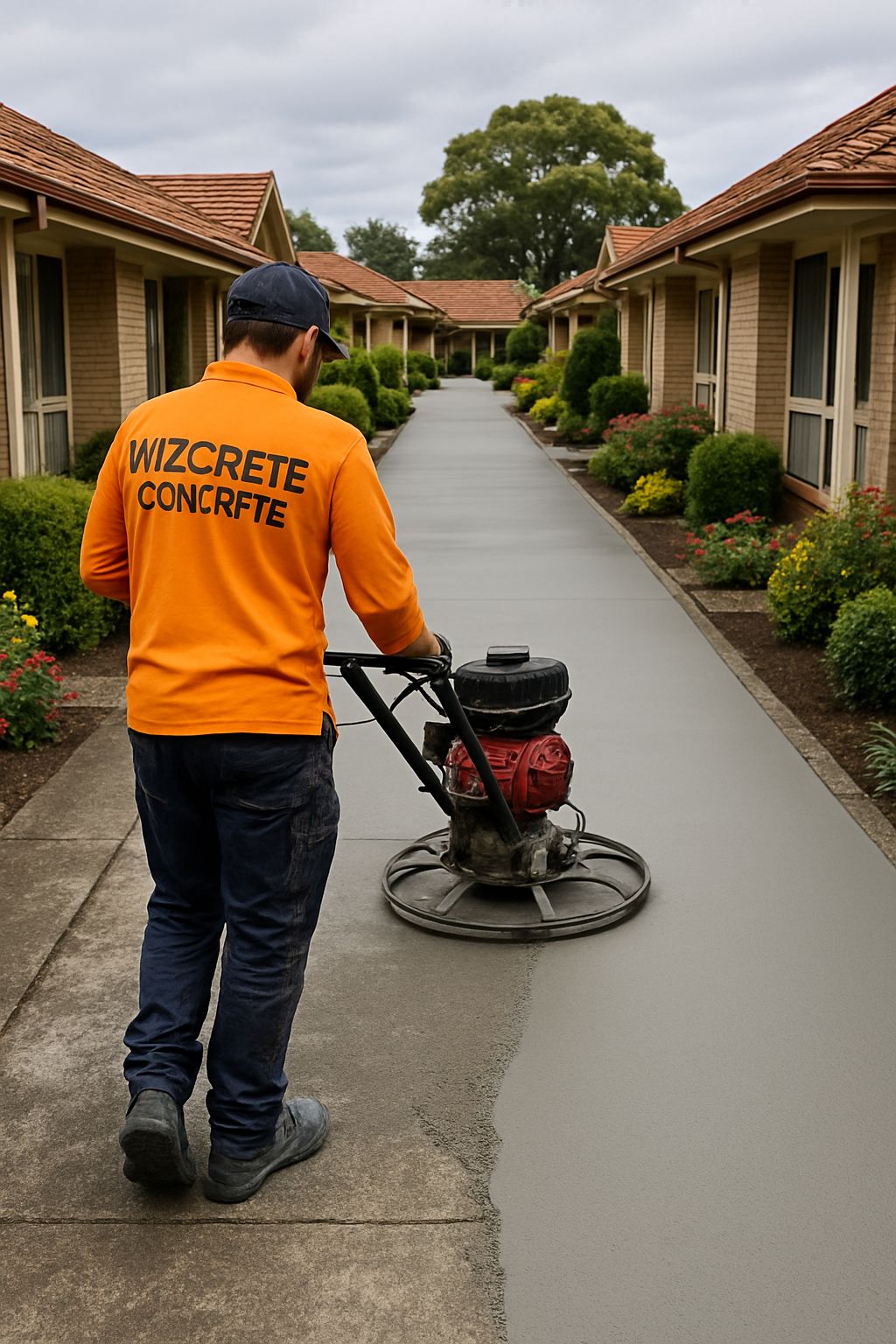
Concrete resurfacing is the technique of applying a new, bonded layer directly over the existing concrete. Instead of breaking and removing the old slab, which is costly, time-consuming, and generates a lot of waste, resurfacing provides the existing structure with a fresh surface that looks new and often performs better than the original.
Depending on the application, the materials used can differ. However, most systems use either a polymer-modified cement overlay, an acrylic coating or a resin-based coating. These materials chemically bond to the prepared concrete underneath, creating a surface that is structurally integrated, rather than simply sitting on top.
How to Bond a New Layer to Existing Concrete
Before you can apply any resurfacing material, you must first prepare the existing concrete. This usually involves using high-pressure water blasting or mechanical grinding to open up the surface pores and remove any contaminants such as oil, paint, or loose material. A bonding primer is then applied, which chemically links the new overlay to the old slab. If this step is skipped, delamination — where the new layer peels away — becomes a real risk within months.
Why Resurface Instead of Replace?
When it comes to the cost difference between resurfacing and a full replacement, it’s night and day. Removing a full slab from a school playground or retirement village pathway means excavation, disposal of the old concrete, reforming, pouring, and curing – a process that can take weeks and cost several times more than simply resurfacing the same area. Resurfacing, on the other hand, can often be completed in days, with little disruption to the facility’s day-to-day operations.
Aspect | Resurfacing | Complete Replacement |
|---|---|---|
Price | Lower — utilises existing slab | High — involves total demolition & pour |
Duration | Typically 3–5 days | 2–3 weeks or longer |
Disturbance | Minimal | Significant |
Waste Produced | Extremely low | High |
Life Expectancy of Result | 10–20 years with upkeep | 20–30 years |
Why Concrete Resurfacing is More Crucial for Schools
Schools are arguably the most strenuous setting for any outdoor surface. Hundreds of children running, jumping, and tripping on the same concrete every day puts a strain on surfaces that most commercial properties don’t have to deal with. Add in years of UV exposure, Sydney’s sporadic heavy rain, and the fact that school maintenance budgets are often stretched thin, and you have a perfect storm for surfaces that wear down quickly and are repaired late.
The Danger of Cracked Playgrounds
Cracks in a school playground are not just an eyesore. A surface crack as small as 5-10mm can trip a running child, and larger cracks, often caused by tree roots or slab subsidence, can create edges of 20mm or more that are real trip hazards. Under NSW law, schools have a duty of care, and a documented surface defect that leads to an injury can result in serious legal and financial consequences for the school and its governing body.
The Impact of Deteriorated Sports Courts on Student Performance
More than just being unsightly, a deteriorated sports court surface can actually alter the game itself. Uneven surfaces can affect the bounce of the ball on basketball courts, worn line markings can cause disputes during PE and competitive games, and a slippery or rough texture can increase the risk of falls during lateral movement. By resurfacing a school sports court with the right texture coating, you can restore a consistent ball response and provide students with a surface that is both safe and suitable for performance.
How Much Can You Save by Resurfacing Instead of Rebuilding a School Playground?
If we take a standard primary school in Sydney with a 500 m² concrete playground as an example, the cost of a full replacement could be between $100,000 and $150,000, or even more. This would depend on factors such as access, drainage considerations, and the type of finish required. However, if you choose to resurface the same area using a high-quality polymer overlay and a slip-resistant texture coating, the cost would be just a fraction of the replacement cost. Plus, the work can be done during the school holidays, meaning there would be no disruption to the school term.
Which Public Spaces in Sydney Can Benefit Most From Resurfacing?
Schools are the most common example, but they’re not the only facilities in Sydney where concrete resurfacing can add significant value. Any high-traffic surface that’s showing signs of wear and tear — and that can’t afford to be out of commission for long — is a potential candidate.
Slip Resistance is a Top Priority in Retirement Villages
For those who run aged care homes and retirement villages, a slip-and-fall accident on a worn-out pathway isn’t just a maintenance problem—it’s a devastating incident for a resident and a major liability for the facility. The elderly are statistically much more likely to be seriously injured by falls, which means that surface texture and slip resistance are non-negotiable in these settings. Concrete resurfacing with an anti-slip aggregate finish increases the surface’s wet pendulum test score, providing facilities with a quantifiable, recordable safety improvement.
Public Walkways and Pedestrian Zones
- Footpaths that have been cracked or raised due to the movement of tree roots
- Public squares and pedestrian plazas with surface spalling
- Ramps and kerb transitions that are no longer in compliance with Australian Building Codes
- Underpass and tunnel walkways with surfaces damaged by moisture
- Park pathways with uneven joints or cracks caused by settlement
The councils of Sydney are responsible for managing thousands of kilometres of concrete pedestrian infrastructure, much of which is overdue for maintenance. The issue for council asset managers is not identifying what needs to be repaired, but prioritising these repairs within a limited budget while maintaining public access.
Concrete resurfacing is a win-win solution. It is possible to work on different sections at different times, allowing foot traffic to continue on nearby paths while one section is being worked on. The cost per square metre is much lower than for a complete pathway reconstruction, meaning councils can cover more ground with the same amount of money.
Another important factor is the need for compliance. The Disability Discrimination Act stipulates that public walkways must adhere to certain standards for surface smoothness and slip resistance. Often, the most effective way to ensure that older walkways meet these standards is to resurface them with a textured overlay, as this avoids the need for a complete reconstruction, which would be more costly.
Resurfacing Sports Courts and Recreation Facilities
Public basketball, tennis, and netball facilities are heavily used but often neglected until they become hazardous. By resurfacing these courts with a purpose-built acrylic or polyurethane sports coating, councils can restore grip, cushioning, and line clarity. This also allows courts to be remarked for multiple sports, improving the use of existing facilities without any structural work.
Body Corporate Managed Multi Apartment Properties
Multi-apartment committees or Body Corporates in Sydney are starting to see the benefits of concrete resurfacing as a smart investment of their capital. Areas such as basement driveways, pool surrounds, visitor parking zones, and pedestrian pathways in multi-family properties are all heavily used and directly affect property values. A resurfaced pool surround with a slip-resistant, UV-stable finish not only looks better at the next open house but also removes a real liability risk from the condominium’s exposure and extends the maintenance cycle by 10 years or more. For more information on services, visit Wizcrete.
Concrete Resurfacing Finishes for High-Traffic Areas
It’s important to note that not all resurfacing systems are created equal, and the best finish depends on the space’s specific use. For instance, a school playground will have different needs than a retirement village walkway or a basement parking garage. Getting the specification right from the start – before any material is laid down – is what distinguishes a resurfacing job that will last 15 years from one that will need to be redone in three.
Across Sydney’s schools and public facilities, three primary systems are used. Each of these systems has distinct performance characteristics and ideal use cases. For more information on the concrete resurfacing process, you can explore detailed guides that cover the benefits and common mistakes to avoid.
1. Spray-On Texture Coatings
Spray-on texture coatings, also known as texture spray or spray pave, are a popular choice for outdoor public spaces. This method involves spraying a polymer-modified cementitious material over the prepared concrete surface, which is then finished with a texture that can be as fine or coarse as needed for the desired level of slip resistance. Spray-on texture coatings are a cost-effective solution for large areas such as school playgrounds and council pathways. Plus, they can be tinted in a variety of colours to match school branding, designate different play zones, or refresh faded line markings on sports courts.
2. Stencilled Concrete Patterns
Stencilled concrete resurfacing involves laying a paper or plastic stencil over the prepared surface before applying the overlay. The stencil is then peeled back to reveal a pattern resembling pavers, tiles, or brick. This technique is particularly effective in schools, where it can be used to create visually engaging playground zones or entrance paths that enhance the overall appearance of the facility. In retirement villages and apartment complexes, stencilled finishes can greatly improve the aesthetic of common areas without the cost of removing and replacing actual pavers.
Our finish is sealed with a surface or penetrating sealer that not only locks in the color but also protects against UV fading and makes the surface easier to clean. We can also incorporate an anti-slip additive into the sealer coat to meet safety requirements in areas prone to wet conditions.
3. Epoxy and Polyurethane Coatings
For areas that are indoors or semi-covered, such as school undercover areas, community hall floors, basement driveways, and corridors in aged care facilities, epoxy and polyurethane resin coatings are the most durable and chemically resistant. A two-part epoxy system bonds directly to the concrete substrate and cures to a hard, seamless surface that can withstand heavy foot traffic, wheeled equipment, and cleaning chemicals. Polyurethane topcoats provide UV stability in areas with partial sun exposure, and both systems can include anti-slip broadcast aggregates to ensure safety compliance.
Selecting a Concrete Resurfacing Company in Sydney
The success of a resurfacing project is only as good as the contractor carrying out the job. Everything from surface preparation to product selection and application technique relies heavily on the expertise and commitment of the team executing the task. In a competitive market like Sydney, there is no lack of service providers — but there is a clear difference between those who do the job right and those who skimp on preparation and use substandard materials to safeguard their profit margin. For more insights on the concrete resurfacing process, check out this comprehensive guide.
- Ask specifically how they prepare the surface — grinding and profiling is the standard; anything less is a red flag
- Request a material specification sheet for the products they’re proposing to use
- Ask for examples of work completed on similar facilities — schools, councils, or aged care sites specifically
- Confirm whether they carry public liability insurance appropriate for work on school or council property
- Ask about their warranty terms and what’s covered if delamination or surface failure occurs
Past project photos tell you a lot, but they don’t tell you everything. Ask whether you can speak directly with a previous client — particularly one from a similar facility type. A contractor who has successfully resurfaced a Sydney school playground or a retirement village pathway and can point you to a reference contact is demonstrating a level of accountability that separates professionals from operators who move on quickly after a job.
Costs should be clear and detailed. If a quote gives you a single total without itemising surface preparation, materials, labour, or any line-marking or sealing work, you can’t properly assess or compare it. Request a detailed breakdown — a trustworthy contractor will have no problem providing it.
Before signing any contract, it is also important to discuss timing and staging in detail. For schools, the preferred timing is during school holiday periods. However, a competent contractor will be able to devise a staging plan that accommodates term schedules if the project is large enough to necessitate multiple phases. For retirement villages and council facilities, the focus is on reducing access disruption for residents and the public. This necessitates a contractor who has previously managed these logistics, rather than one who is figuring it out on the fly.
What You Can Learn From Previous Projects
- Look for finished projects on similar facilities to yours, such as schools, aged care facilities, or council properties
- Ask if the finish has endured multiple wet seasons without delamination or surface cracking
- Check to see if line markings, if applicable, are still clear and readable after normal use
- Examine the edges and transitions – hasty feathering around drains or expansion joints indicates rushed preparation work
- Ask directly when the project was completed and whether any warranty claims were made
A contractor’s portfolio is their most truthful sales pitch. Photos of newly completed work look good on almost any job – what’s important is how a surface looks after two or three Sydney summers of UV exposure, heavy foot traffic, and the occasional heavy rain. If a contractor can’t show you work that’s at least 12 to 18 months old and still performing well, that’s a gap worth probing. For more insights, you might want to explore the concrete resurfacing process and benefits.
Also, take a look at the diversity of their portfolio. A contractor who has only ever resurfaced residential driveways is a different kettle of fish from one who has completed projects at primary schools, retirement villages, and council-managed recreation facilities. The surface preparation standards, safety compliance requirements, and logistical complexity of institutional projects differ significantly from those of residential work. For example, school paths and play areas require specific solutions to meet these unique demands.
Not enough people in this industry take the time to check references. Many facilities managers are content to look over a portfolio of photos and then go straight to comparing quotes. However, a quick five-minute phone call with a school business manager or a retirement village operations coordinator who has previously worked with the contractor can tell you more than any glossy brochure. Be sure to ask the reference about the contractor’s communication during the job, whether they followed the staging plan, and if there were any problems with the finish in the months after the job was completed. For more insights, consider exploring the concrete resurfacing process and benefits.
What to Ask Before You Sign on the Dotted Line
Before you sign any contracts, make sure you have clear answers on the method of surface preparation, the specific product system that will be used, how long it will take to cure before the space can be used again, and what the warranty covers and for how long. A contractor who can answer these questions without hesitation is experienced and can be trusted with your facility. If a contractor gives vague answers or avoids answering questions about product specifications, it’s a red flag about how they operate.
Make sure you also know who will be doing the work. Subcontracting is a common practice in Sydney’s bustling construction industry, and the team that shows up to start the job might not be the same one you signed a contract with. Don’t be afraid to ask if the work is going to be done by their team or a subcontractor, and if it is a subcontractor, make sure to ask about their experience with institutional facilities.
Resurfacing Concrete is a Cost-Effective Solution for Sydney Facilities
For schools, councils, and aged care facilities, resurfacing is often a more cost-effective solution than full replacement. This is particularly true for structurally sound surfaces with cosmetic and functional issues. Resurfacing can save a significant amount of money, typically 50 to 70 percent less than the cost of replacing the entire slab for similar areas. Additionally, the reduced downtime means that facilities can return to normal operations more quickly. Over a 10 to 15-year period, with basic maintenance, resurfacing provides excellent value per square meter, keeps safety risks to a minimum, and delays the much larger capital expenditure of full reconstruction until later in the asset’s lifecycle.
Common Questions
We are frequently asked by facility managers, school principals, and body corporate committees about concrete resurfacing in institutional settings. The answers we provide below are based on our real-world experience in Sydney’s climate and high-traffic environments.
Knowing what will happen before, during, and after a resurfacing project can make the decision-making process easier and help everyone involved — from the maintenance team to the people who will use the space — know what to expect.
What is the Durability of Concrete Resurfacing in High-Traffic Areas Such as Schools?
Provided that the concrete resurfacing system has been properly prepared and applied, it can last from 10 to 20 years in high-traffic areas such as school playgrounds or council pathways. The lifespan of the resurfacing system depends on the type of system used, the quality of preparation, and the level of maintenance. Epoxy and polyurethane systems are generally more durable, while spray-on texture coatings in outdoor, exposed environments usually need recoating after 10 to 15 years.
Many facility managers underestimate the importance of maintenance. Regular cleaning to remove the abrasive grit and debris underfoot, quick attention to any minor cracks or edge lifting, and periodic resealing in high-wear areas can significantly extend the surface’s lifespan and delay the next major resurfacing cycle.
Is it possible to resurface concrete in stages to minimise disruption?
Definitely – in fact, for most schools and large public facilities, staging is the norm rather than the exception. A playground, for example, can be divided into zones, with one area being resurfaced while the rest remains open. Council footpaths can be worked on in alternate sections, with pedestrian diversion signs keeping foot traffic flowing. The main requirement is that each staged section has enough time to cure before it is reopened, and that the contractor has considered staging logistics in their project timeline from the beginning, rather than as an afterthought. For more insights on commercial concrete resurfacing benefits, explore our detailed guide.
Can Resurfaced Concrete Withstand Sydney’s Outdoor Weather Conditions?
The weather in Sydney can be a challenge for outdoor concrete surfaces. High UV intensity, heavy rainfall, and temperature fluctuations that cause concrete to expand and contract are all common. However, high-quality resurfacing systems are designed to cope with all of these conditions. Polymer-modified overlays are flexible and can accommodate slab movement without cracking. UV-stable pigments prevent colour fade from sun exposure, and properly sealed surfaces repel moisture instead of absorbing it. For more information, check out this guide on concrete resurfacing.
One of the key factors to consider is the product’s quality and the correct specification. If you use a resurfacing system designed for indoor use outdoors, or if you apply a product outside of its recommended temperature range, it will not perform well in Sydney’s conditions. This is why the product specification is so important. You need to not only consider the type of finish, but also the specific formulation and how it has been tested for performance in outdoor applications exposed to UV light.
What Safety Standards are Applicable to Resurfaced Surfaces in Public Spaces?
In New South Wales, resurfaced surfaces in public spaces are required to meet the slip resistance standards as specified in AS 4586, the Australian Standard for slip resistance classification of new pedestrian surface materials. Wet areas, ramps, and surfaces adjacent to pools typically require a minimum classification of R11 or higher on the ramp test, or a Pendulum Test Value (PTV) of 36 or higher under wet conditions. A reputable contractor based in Sydney can specify the slip-resistance classification of the system they’re proposing and confirm that it meets the requirements for your specific application, whether that’s a school playground, a retirement village pathway, or a council ramp.
How Long Does It Take for a Resurfaced Area to Be Usable Again?
It depends on the system and the conditions. In typical autumn or spring weather in Sydney, a spray-on texture coating is usually ready for foot traffic within 24 to 48 hours after the final coat is applied. Epoxy systems usually require 24 hours to support light foot traffic and up to 72 hours to support heavy use or vehicle traffic. Polyurethane topcoats increase cure time, depending on the number of coats applied.
Climate factors such as temperature and humidity can greatly influence curing times. For example, a resurfacing project carried out in the height of Sydney’s summer may cure more quickly. However, high temperatures can also affect the application window and the quality of the finish if the contractor does not carefully manage the conditions. In colder or damper weather, curing times can increase – sometimes significantly. Therefore, a contractor who guarantees a set reopening date, regardless of the weather, may be making a promise they cannot fulfil.
For schools, the best time to complete the work is at the beginning of a school holiday period. This allows the surface a full two weeks to cure and any residual odour from sealers or resins to dissipate before students return. This also allows time for a post-cure inspection and any touch-up work on line markings or edge zones before the area is back in full use.
Contract Wizcrete Concrete and lets discuss your needs