
Article-At-A-Glance: Mastering Steep Driveway Construction
- Building a steep concrete driveway with steps requires careful planning, expert excavation techniques, and high-quality materials to ensure safety and longevity
- The standard thickness for concrete driveways on hillsides in Gordon NSW should be at least 125mm, with suitable reinforcement to prevent cracking and movement
- Step dimensions must comply with specific height-to-width ratios, and landings must be placed strategically to ensure maximum safety and accessibility
- Drainage solutions are essential for hillside properties to prevent water damage and erosion, which can undermine concrete structures
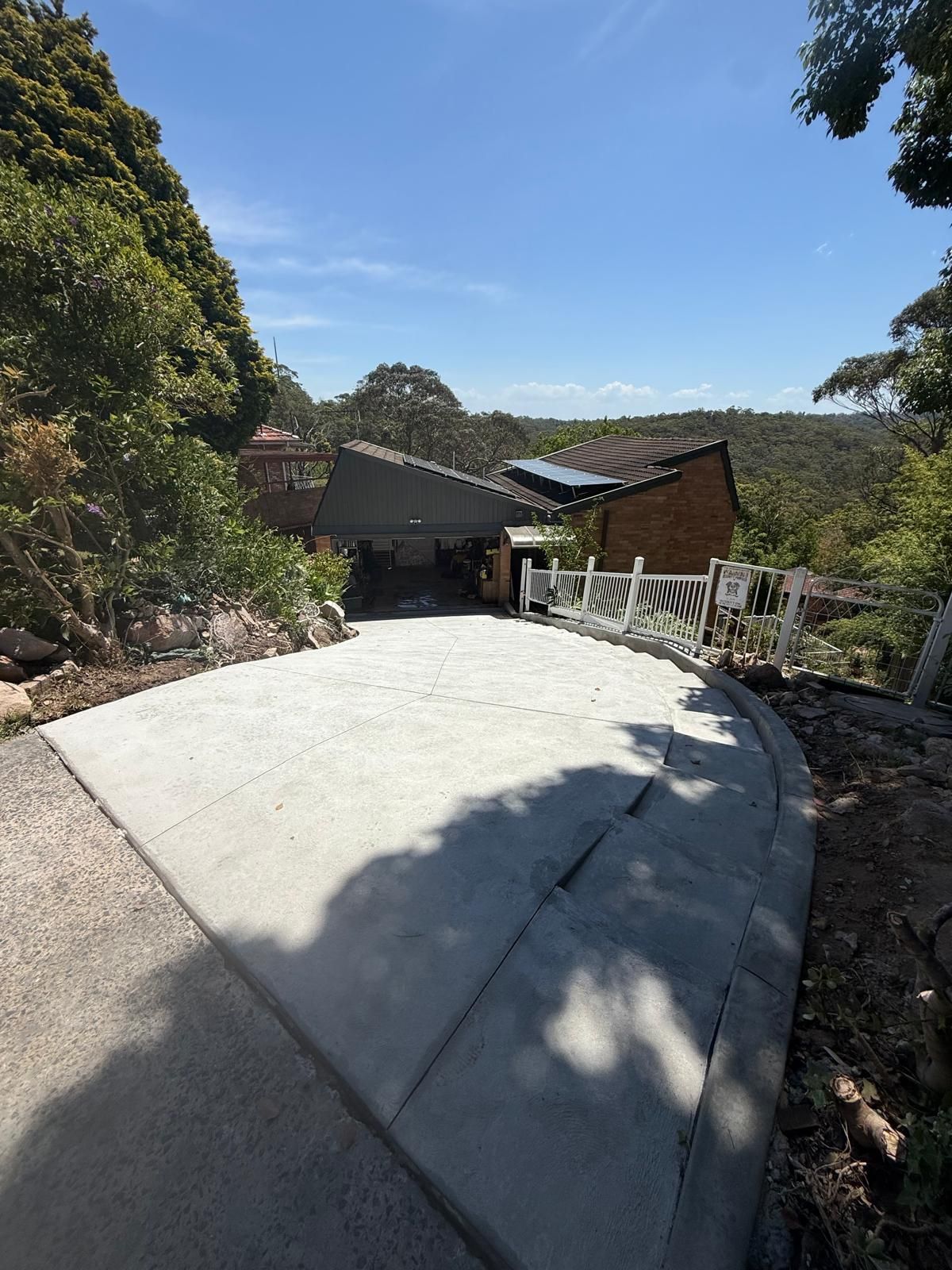
- Wizcrete has successfully completed complex 70m² concrete driveway projects with up to 20 integrated steps for steep properties in Gordon
Dealing with a steep property in Gordon NSW doesn’t have to mean struggling with a dangerous or impractical driveway. A well-designed concrete driveway with integrated steps can turn your challenging slope into a functional, safe, and attractive entrance to your home. With the right strategy, even the steepest sites can be tamed with proper planning, materials, and construction techniques.
The Steep Driveway Challenge in Gordon NSW
The beautiful hills of Gordon provide a breathtaking backdrop and unique character to homes, but they also pose a major obstacle when it comes to building driveways. The steep geography of this North Shore suburb calls for specialized solutions that aren’t necessary for flat land. Wizcrete has risen to these challenges, developing a specialty in creating functional access solutions for even the most challenging sites.
The Reason Conventional Driveways Don’t Work on Gordon’s Slopes
Conventional driveway methods often fail to meet the needs of Gordon’s steep slopes. The main problem is the slope itself – conventional driveways have a hard time coping when gradients exceed 1:6 (approximately 17%). After this point, cars start scraping their undersides, traction becomes an issue, and it becomes increasingly dangerous for pedestrians. Regular concrete also tends to break down faster on steep slopes due to the increased speed of water runoff and erosive forces.
The weather significantly exacerbates these problems. In Sydney’s heavy rain periods, poorly designed steep driveways become waterslides, directing powerful currents that wear away the supporting soil and compromise the structural integrity. Even slightly wet surfaces can become dangerous slopes on winter mornings when the temperature drops. For those dealing with these challenges, consider exploring steep concrete driveway installation solutions to enhance safety and durability.
- Slope gradients that are too steep and exceed council regulations (usually over 25%)
- Poor drainage systems that cause erosion and undermining
- Concrete thickness and reinforcement that are not sufficient for hillside stress
- Jointing that is not adequate and allows water to penetrate, leading to cracking
- Surface textures that are substandard and become dangerously slippery when wet
Dangers of Poorly Designed Slopes
The consequences of a poorly designed steep driveway are not just inconvenient, they can also be dangerous. Safety risks become a significant concern when the proper steps, landings, and surfaces are not included. Vehicles can slip or roll on slopes that are too steep, especially in the wet weather conditions that are common in Sydney. The risks for pedestrians are even higher, with falls being surprisingly common on poorly designed driveways.
Another important aspect that is often overlooked is emergency access. If the driveway is not properly designed for their vehicles, ambulance and fire services may have difficulty reaching your property. There are also implications for insurance, as providers may increase premiums or deny claims for properties with driveway designs that are not compliant and pose obvious safety risks.
Preparing for Your Steep Concrete Driveway Project
Every successful steep driveway project starts with careful planning that takes into account the unique conditions of your property. This is the stage where you will make important decisions about how to manage the gradient, integrate steps, and choose materials. For insights into the installation process, you can refer to this steep concrete driveway installation guide. These decisions will determine the direction of the entire project. By getting this foundation right, you can avoid costly changes down the line and ensure that your driveway serves its purpose and meets all regulatory requirements.
Here are the steps to install a steep concrete driveway with steps in Gordon, NSW:
- Perform a comprehensive site assessment to understand the type of soil, drainage patterns, and any existing structures on the site.
- Get in touch with the Gordon Council to learn about specific regulations for the slope and any required permits.
- Understand the requirements of the vehicle, including the clearance height and turning radius.
- Plan pedestrian access routes to integrate with vehicle pathways.
- Consider the budget constraints and balance them with the requirements for long-term durability.
Given the complexity of installations on hillsides, it is rare for DIY approaches to be successful. You can expect significantly better outcomes if you get professional help for the design. This is particularly true when you work with experienced contractors like Wizcrete. They can identify site-specific challenges early on. Our projects in Gordon benefit from years of local knowledge about the conditions of the soil, weather patterns, and the expectations of the council. This knowledge is specific to properties on the North Shore.
Always bear in mind that every dollar you spend on adequate planning will save you several dollars in future repairs or modifications. The most costly driveway is the one you have to build twice – a situation we’ve seen time and time again when homeowners try to cut corners on initial design and engineering consultation.
Why Your Property is Unique: Site Assessment
Every property in Gordon is unique and has its own challenges. This is why a customised assessment is so important for the success of steep driveway projects. A professional site evaluation looks at many factors including how water naturally drains, how stable the soil is, and what vegetation is already there. The direction the property faces is also very important. For example, driveways that face south get less sun. This can lead to problems with moss growing and the driveway taking longer to dry after it rains.
Understanding Council Regulations and Permits in Gordon NSW
Understanding the requirements of the Ku-ring-gai Council is an essential first step in your driveway project. Most properties in Gordon require development approval for driveways that exceed certain gradients or dimensions. The council typically limits the maximum driveway gradients to 25% (1:4) and has specific requirements for transitions at the property boundary and near garages.
In Gordon, driveway applications often come with stormwater management plans. These plans show how to catch and channel runoff. Some Gordon precincts have heritage overlays, which put more restrictions on material choices and visual impact. Working with contractors who know the local council’s expectations makes this process much easier. It also stops you from having to redesign everything, which can be very expensive.
Drainage Solutions for Hillside Properties
Water management is a critical aspect of designing steep driveways in the hilly environment of Gordon. Improper drainage does not just create inconvenient puddles, but it actively undermines your concrete investment through erosion and freeze-thaw cycles. Effective solutions must account for both surface water and subsurface moisture that can destabilize your driveway foundation. For more insights, consider exploring the benefits of hiring local concrete contractors for your driveway projects.
Strategically placed channel drains across the driveway path catch running water before it can pick up enough speed to cause damage. For particularly steep sections, herringbone patterns stamped into the concrete surface help guide water toward drainage channels, preventing the straight-line runoff that speeds up erosion. Subsurface drainage systems that use agricultural pipe wrapped in geotextile fabric keep water from building up under the concrete slab. For more information on effective drainage solutions, check out our cost-effective concrete resurfacing tips.
By incorporating your driveway solutions with the overall drainage systems of your property, you can avoid simply moving issues to another part of your property. Each project in Gordon needs a comprehensive approach that takes into account where the water ends up after it leaves your driveway. For more insights, consider the best Ku-ring-gai concrete contractor for driveway projects.
Creating Practical Steps for Steep Driveways
When slopes become too steep to handle, integrated concrete steps become a necessity for both cars and pedestrians. The process of creating these steps requires a delicate balance between the ratio of rise to tread, where to place the landing, and how to integrate it seamlessly with the surface of the driveway. Each component must work in harmony to create a solution that is safe, long-lasting, and visually appealing.
Calculating the Ideal Step Height and Width
For the safest and most comfortable step dimensions, it’s best to stick to tried and true ergonomic principles. For outdoor steps in Gordon, a rise (or height) of 125mm to 175mm and a tread (or depth) of at least 280mm is the ideal combination. This allows for enough space for your foot to fit comfortably on the step without taking up too much space, which is especially important for properties on hillsides where space may be limited.
It’s important to have uniformity in the steps. Even a 5mm difference in height between steps can create a tripping hazard because our muscle memory expects each step to be the same height. Professional-grade formwork and careful measurements ensure that each step is the same height. This can be especially challenging on hilly terrain.
Step Design Guidelines for Gordon Hillside Properties:
Maximum Rise (height): 175mm
Minimum Tread (depth): 280mm
Optimal Rise-to-Tread Ratio: 1:2
Maximum Consecutive Steps: 18 before landing requirement
Minimum Landing Depth: 750mm
Vehicle considerations add another dimension to step design calculations. Where driveways combine steps with ramps for vehicle access, the concrete surface between steps must maintain appropriate clearance for your specific vehicles. This typically means designing longer, more gradual transitions that prevent undercarriage damage while still managing the overall slope effectively.
Where to Place Landings for Safety
Landings are crucial in the design of stepped driveways for several reasons. They offer necessary rest stops for pedestrians making their way up or down the property. Although building codes usually mandate landings every 18 consecutive steps, we suggest placing them more frequently—around every 8-10 steps—on especially steep properties in Gordon for increased comfort.
Landings can also serve as practical areas for everyday activities such as collecting mail, placing garbage bins, or transitioning from vehicles to walkways. The best designs take into account how residents will use these spaces on a daily basis, rather than just meeting the minimum code requirements.
For sites that are very steep, landings with 90-degree turns are a great way to handle changes in elevation while also creating natural places to stop and rest. This design requires more horizontal space, but it is much safer than a straight-run design on a steep slope.
Handrail Necessities and Choices
Safety laws require handrails for any publicly available stairs with over three risers, but they offer critical support on Gordon’s steep properties even when not legally mandated. Modern handrail systems blend function with style using materials such as powder-coated aluminum, stainless steel, or integrated concrete features that match your property’s design theme. For more on ensuring quality and compliance, consider hiring licensed concrete contractors in NSW.
Choosing the Right Materials for Sloped Installations
Steep driveways call for robust materials that can endure the extra mechanical strains and weather-related issues. Ordinary concrete specs just won’t provide the durability you need for hillside properties in Gordon.
The materials you choose will not only affect the initial look, but also the long-term durability and care needs of your investment. If you try to cut corners at this point, you’ll likely end up with early wear and tear and costly fixes. For more insights, consider the concrete driveway resurfacing tips to ensure your investment holds its value over time.
Today’s advanced concrete technologies have made it possible to build on challenging sites. We now have specialized admixtures and reinforcement systems that have been specifically engineered for slope applications. These modern solutions perform significantly better than the methods we were using just ten years ago. For more insights, check out this concrete driveway installation guide.
High-Strength Concrete Mix (25MPa+)
Traditional residential concrete (20MPa) is not strong enough for hillside applications where erosion, vehicle weight, and possible ground movement create extraordinary demands. For steep driveways in Gordon, we specify a minimum of 25MPa concrete, with 32MPa preferred for the best durability. This stronger mix offers better resistance to cracking, surface abrasion, and moisture penetration that would quickly compromise weaker materials.
Specialized admixtures are crucial to the performance of steep driveways, in addition to basic strength ratings. Water-reducing agents increase workability without sacrificing strength, which is particularly important when placing concrete on slopes where traditional finishing techniques are difficult. Air-entrainment additives create tiny air bubbles that accommodate freeze-thaw cycles, while accelerators or retarders help control setting times depending on weather conditions and placement challenges.
Reinforcement Choices: SL72 Mesh and More
Appropriate reinforcement can help to prevent the hairline cracks that are bound to form from becoming structural issues on steep installations. The minimum acceptable reinforcement for hillside driveways in Gordon is standard residential SL72 mesh (7.2mm diameter bars at 200mm spacing), but for best results, heavier SL82 is recommended. The positioning of the mesh is just as important—it needs to be situated in the middle third of the slab thickness and properly supported by chairs at the specified intervals. For more information on driveway installations, check out this concrete driveway installation guide.
- SL72 mesh: Minimum standard for residential driveways with moderate slopes
- SL82 mesh: Preferred for steeper gradients and vehicle traffic areas
- Fiber reinforcement: Secondary system complementing (not replacing) steel mesh
- Edge thickening: 50% increased thickness at vulnerable perimeter sections
- Dowelled joints: Load transfer systems for stepped sections and expansion joints
For particularly challenging sections where soil stability is questionable, we sometimes recommend additional measures such as steel bar reinforcement at specific stress points. This targeted approach addresses unique site conditions while maintaining cost-effectiveness across the broader installation.
Why Colored Concrete is Great for Steep Driveways
Not only does it look good, but colored concrete also has practical benefits for installations on steep driveways in Gordon. The color is added to the concrete mix itself, so it goes all the way through, not just on the surface. This means it’s more durable in areas with lots of traffic, and if it gets chipped or scratched, you won’t see grey concrete underneath because the color goes all the way through.
Ensuring Concrete Cures Correctly in Gordon’s Weather
The key to having a concrete surface that lasts for many years instead of one that wears down too soon is proper curing, especially in the exposed hillsides of Gordon. The first 7 days after the concrete is poured are the most important because this is when the concrete builds up its basic strength. Keeping the moisture levels and temperature steady during this time will protect your investment from the changing weather in Sydney.
When it comes to steep driveways, we use specific curing compounds that create moisture-holding membranes. This is especially crucial on sloping surfaces where water naturally flows off instead of sinking in. We apply these compounds right after finishing when the concrete is still wet. On very hot or windy days, we take extra steps like using wet hessian covers or fine misting systems to prevent fast moisture loss that can cause shrinkage cracking.
The weather in Gordon is unique, with hot summers and the occasional heavy rain. We keep a close eye on the weather forecast before scheduling any pours, making sure to avoid days with extreme temperatures that could impact the quality of the curing. The perfect curing temperature range is 10-32°C, as this allows for the best chemical reactions within the concrete matrix.
Our Work Speaks for Itself: Success Stories from Gordon NSW
Our work is our calling card. All across Gordon and the surrounding North Shore suburbs, our stepped concrete driveway installations have turned dangerous and impractical slopes into functional, attractive property entrances. The projects we’ve completed are a testament to our technical expertise and an eye for aesthetics that fits right in with Gordon’s prestigious streetscapes.
Revamping a 70m² Driveway with 20 Steps
One of the most challenging projects we’ve recently undertaken in Gordon was a 70m² driveway installation with 20 built-in steps on an extremely steep slope. The existing driveway was dangerously steep and eroded, making it unsafe for the homeowners to access their garage when it rained. The house’s narrow frontage and significant change in elevation required careful planning to ensure cars could still access the property while also providing safe pedestrian access.
We solved the problem by getting rid of the old, worn-out concrete using special excavators made for working on steep terrain. We came up with a switchback design that handled the slope well and fit within the property lines. The final result was a driveway made of exposed aggregate concrete with smooth-finished step edges that stand out, along with built-in LED lights for safety at night.
Ultimately, the renovation has drastically altered the way the homeowners engage with their land, providing secure access at all times, regardless of the weather. The aesthetic upgrade also significantly improved the house’s curb appeal, with the architectural concrete elements adding to the house’s design rather than detracting from it.
Before and After: Visual Impact
Properly designed stepped driveways not only serve a functional purpose but also visually transform the property. Many Gordon properties that we come across have unsightly eroded slopes, patched asphalt, or crumbling concrete that detract from the otherwise beautiful homes. The “before” state often includes makeshift solutions like loose gravel or temporary wooden steps that are not only a maintenance headache but also a safety concern.
Once finished, these same properties display flowing, architectural concrete elements that look like intentional design features rather than necessary compromises. The clean lines of properly formed steps, contrasting textures between driving and walking surfaces, and integrated landscape elements create a cohesive entrance experience that enhances property value while solving practical access challenges. For more insights on how to boost home resale value with concrete work, check out these concrete driveway resurfacing tips.
- Real estate agents who specialize in Gordon’s high-end market have reported increased property values
- There have been no reported slip incidents after installation, greatly improving safety
- Compared to previous driveway solutions, maintenance requirements have been reduced
- Enhanced accessibility for elderly residents and visitors with mobility challenges
- Improved stormwater management preventing property flooding issues
What’s most compelling are the testimonials from Gordon residents who can finally navigate their properties without concern during Sydney’s frequent rain events. Many report that their driveways have transformed from being their property’s greatest liability to becoming a distinctive architectural feature that draws positive comments from visitors. For more information on concrete driveway projects in Gordon, visit Wizcrete’s installation guide.
Keeping Your Stepped Concrete Driveway in Top Shape
When installed correctly, a concrete driveway in Gordon can last for many years, but taking a proactive approach to maintenance can extend its life and keep it looking great. The stepped design of the driveway introduces some unique maintenance considerations, including joint integrity, drainage systems, and surface treatments, that are not factors with a standard flat driveway. By developing a systematic maintenance plan, you can protect your investment and prevent premature deterioration.
Yearly Upkeep Plan
Given Sydney’s unique seasonal changes, there are specific upkeep needs that arise throughout the year. For instance, in Autumn, it’s crucial to remove leaf litter and organic debris from drainage channels and the edges of steps before the winter rains set in. This helps to prevent surfaces from becoming slippery and ensures that water will flow down the intended drainage paths instead of damaging your concrete structure.
Spring is the perfect time to do a thorough pressure wash to get rid of the dirt and grime that winter left behind, as well as any moss or algae that might have grown in shady areas. During the summer, you should check the expansion joints and sealants that might have been affected by thermal expansion. By creating a maintenance schedule based on the calendar, you can make sure you don’t forget to do any important tasks as the seasons change.
Lengthening the Life of Your Driveway with Proper Maintenance
Aside from basic cleaning, there are several proactive steps you can take to significantly lengthen the life of your concrete driveway in the challenging hillside environment of Gordon. Applying a good quality penetrating sealer every 2-3 years is a crucial step in protecting against moisture penetration. This is especially important for steps and landings where water naturally gathers. Modern silane-siloxane sealers provide an invisible layer of protection without creating a glossy finish that can become slippery when wet.
Another crucial aspect that homeowners often neglect is joint maintenance. The flexible polyurethane sealants in expansion joints will eventually wear out and should be checked every year. Any sections that are cracking or separating should be replaced. This easy maintenance task can prevent water from penetrating and potentially reaching the subgrade, which could compromise the structural integrity. For more detailed guidance, check out the concrete driveway installation guide.
Addressing minor issues quickly can prevent them from turning into larger problems. Hairline cracks, while unsightly, usually don’t indicate structural problems unless they widen beyond 2mm. However, they should be sealed to prevent water penetration, especially before winter. Professional-grade crack fillers designed specifically for exterior applications provide lasting protection while remaining flexible enough to accommodate normal concrete movement.
Here is the human-written version of the content:
Gordon Driveway Annual Maintenance Checklist:
• Pressure wash surfaces (in spring and autumn)
• Clear all drainage channels and ensure they are flowing properly
• Inspect and replace joint sealants as needed
• Check the edges of the steps for chipping or damage
• Check handrails for stability and rust
• Check the surface for sealer effectiveness
• Document any new cracks or sinking
When to Bring in the Pros
While regular maintenance can often be done by homeowners, there are certain situations where you should bring in a professional. If there is any significant cracking (wider than 2mm), noticeable sinking, or if the driveway is pulling away from adjacent structures, these are signs that there may be underlying issues that need to be evaluated by a professional. Similarly, if there are drainage issues that persist after you’ve cleared any visible blockages, this may indicate that there are design issues or issues under the surface that need to be addressed by a professional.
For homes in Gordon where drainage systems are part of wider stormwater management solutions, it’s a good idea to have a professional inspection every year. This can help to spot any potential problems before they become major issues. The small cost of this kind of preventative maintenance is nothing compared to the cost of major repairs or replacement if problems are left unchecked. For more on maintaining your property, check out these concrete driveway resurfacing tips.
Your Road to a Flawless Steep Driveway
Turning your difficult Gordon property into a secure, usable and appealing entrance starts with expert design and carries on through top-notch installation and continual upkeep. The most successful projects balance immediate budget constraints against long-term performance, realizing that properly carried out concrete driveway installations represent infrastructure investments that boost both property functionality and value for decades to come.
Common Questions
We’ve worked on many Gordon driveway projects and have noticed that homeowners often have the same questions about this important property improvement. These answers cover the most frequently asked questions and give practical advice for your particular situation.
What is the price of a steep concrete driveway with steps in Gordon NSW?
In Gordon, the usual price for stepped concrete driveways ranges from $350-$550 per square metre, due to the complexity of installing on a hillside and the high-quality materials needed. A typical 70m² driveway with built-in steps will cost between $24,500 and $38,500, depending on the specific design elements, finish choices, and site difficulties. This price range includes full solutions such as excavation, drainage systems, concrete installation, and finishing treatments. Properties with exceptional access difficulties or that require retaining structures will be at the higher end of this range.
What is the installation timeline for a steep driveway with steps?
On average, installing a stepped driveway in Gordon takes between 8 and 15 business days. This timeline can change based on the complexity of the project and the weather. The breakdown of the timeline is as follows: 2-3 days for demolition and excavation, 2-4 days for installing drainage and preparing the base, 2-3 days for formwork and reinforcement, 1 day for placing the concrete, and 1-2 days for finishing and detailing. After the installation, the concrete needs about 7 days to cure before it can handle vehicle traffic. However, it can usually handle foot traffic after 24-48 hours.
The weather plays a big role in determining the schedule, especially during the unpredictable rainfall periods in Sydney. Good contractors will factor in weather contingencies in their timelines and will also communicate openly about any potential delays. Stepped installations require a high level of precision, so rushing the process will inevitably compromise the quality and longevity of the installation.
Are stepped concrete driveways safe for vehicles?
Guidelines for Vehicle Compatibility:
Standard Sedan: Gradients up to 1:6 (17%)
SUV/4WD: Gradients up to 1:4 (25%)
Sports Cars: Gradients up to 1:8 (12.5%)
Service Vehicles: Gradients up to 1:6 (17%)
Emergency Access: Minimum 3.5m width with 1:6 maximum gradient
Stepped driveways, when designed properly, create separate zones for vehicle access and pedestrian movement. The vehicle sections have more gradual inclines that respect the limitations of your specific vehicles, while steeper sections incorporate steps exclusively for foot traffic. This hybrid approach maximizes functionality while working within the constraints of Gordon’s challenging topography.
We pay special attention to the transitions between gradient changes in our designs, as these are the areas where there is the most risk of damage to the undercarriage of your vehicle. We make these transitions gradual and measure them carefully based on the ground clearance and wheelbase dimensions of your specific vehicles. If you have more than one vehicle, we design to accommodate the vehicle with the most limiting specifications. For more insights on driveway projects, check out the benefits of hiring a local Sydney concrete contractor.
For particularly difficult locations, unique driveway designs such as switchbacks or curved approaches can help handle drastic changes in elevation while ensuring safe vehicle access. These solutions need more horizontal space, but they significantly enhance usability compared to straight-run approaches on steep slopes.
Which type of concrete finish is the most slip-resistant for steep driveways?
- Exposed aggregate (medium exposure): This finish is not only comfortable for bare feet, but it also provides excellent traction.
- Broom finish: This is a cost-effective solution that offers directional traction patterns.
- Stamped concrete with texture: This finish provides a decorative appeal while also offering functional slip resistance.
- Silicon carbide additives: These additives can be broadcast into almost any finish to provide enhanced grip.
In Gordon, we usually recommend an exposed aggregate with medium stone exposure for steep driveways. This finish offers the perfect balance between traction, durability, and aesthetic appeal. It exposes the natural stone aggregate through controlled surface retardation and pressure washing, which creates textural variations. These variations provide grip in all weather conditions without being uncomfortably rough for pedestrians.
The choice of aggregate size and type is crucial for both looks and practicality. Smaller aggregates (5-7mm) offer a smoother texture and more uniform grip, while larger stones (10-14mm) give a stronger visual effect but perhaps a less even grip surface. The local Gordon sandstone aggregates are a perfect match for the natural landscape and also offer excellent slip resistance.
We typically suggest contrasting smooth-troweled bands for step edges. This visually separates each step and provides a comfortable seating area on the edge. The smooth sections are only on the horizontal surfaces, while all sloped areas have suitable texture treatments.
For especially steep areas or places that don’t get much sun and therefore tend to have a lot of moss, anti-slip additives can provide an extra layer of protection. You can use modern aluminum oxide treatments to improve traction in wet conditions without changing how the concrete looks.
How do stepped driveways fare in Sydney’s heavy rain?
When designed properly, stepped driveways can actually perform better than traditional sloped driveways during heavy rainfall in Sydney. The steps create natural breaks in the water flow, preventing the high-speed runoff that can cause erosion on a continuous slope. Each flat step interrupts the flow of water, directing it towards built-in drainage systems instead of letting it build up enough force to cause damage.
Effective drainage integration is key to ensuring that your driveway performs well in wet weather. Our installations in Gordon include multiple drainage elements. These include hidden strip drains along the edges of steps, strategically placed grates at landings, and subsurface drainage systems in areas that are particularly vulnerable to water damage. These elements are designed to work together as a comprehensive solution for water management, rather than relying on a single approach to drainage. For more insights, check out our steep concrete driveway installation in East Killara.
One of the main factors that affects how well a concrete driveway will hold up in wet weather is the type of concrete used. We use a type of concrete with a low water-to-cement ratio, which results in a denser, less permeable surface that is particularly resistant to water penetration. This is especially important in Sydney, where we occasionally get cold snaps that can cause freeze-thaw damage. To provide additional protection, we also use surface treatments like penetrating sealers, which prevent water absorption without compromising slip resistance. For more insights, check out our concrete driveway resurfacing tips to boost your home’s resale value.
You haven’t provided any content to rewrite.
